
Why Writing FOR AI Is Killing Your Rankings
Writing for AI instead of writing for people, here is the uncomfortable truth: your rankings probably are not doing what you think they are doing.
You optimize the keywords for Google. You hit the word count that Google expects. You follow the heading structure that every search engine optimization checklist tells you to.
For a while it actually works. Impressions climb; the page starts showing up on Google. Then it just stops. Clicks flatline on Google. Position barely budges on Google. No matter how much more keyword tweaking you throw at it, nothing moves on Google.
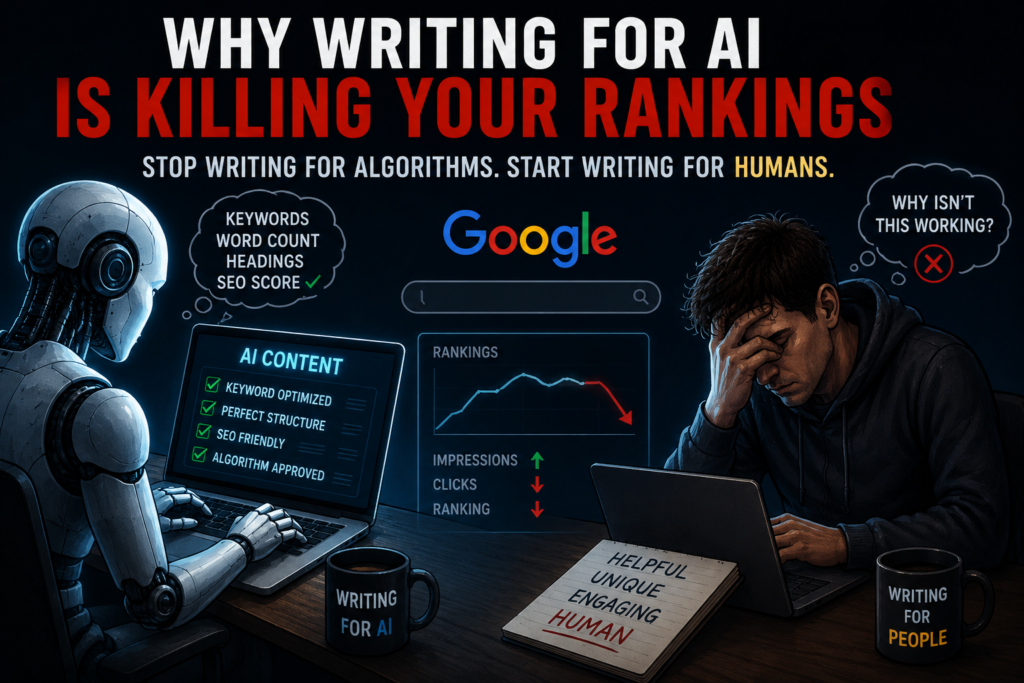
That plateau is not luck. It is usually a sign that the content was written for intelligence and algorithms first. And for the person actually reading it second. Not at all.
The content was written for Google and other search engines but not for people.
What Writing For AI Actually Looks Like
Once you know what to look for, this kind of content is easy to spot.Writing for AI often looks optimized on the surface, but the content can feel repetitive and predictable to real readers.
- The target keyword shows up in every other sentence.
- The article hits all the expected points, not because they genuinely help anyone.
- Because a checklist said to include them.
- The writing feels smooth on the surface but strangely hollow underneath.
- Technically fine, forgettable in practice.
- The writing is good for Google. Not for people.
I have seen this play out firsthand.
One blog post I reviewed got a bump in impressions right after publishing, but clicks and average position barely moved after that, even with more keyword work poured into it.
When I actually dug into the content, the pattern was obvious:
- keyword repetition,
- the same common talking points every competitor already covered
- and almost nothing original or genuinely useful.
It read fine on Google. It just did not say much to people.
The fix was not search engine optimization. It was making the thing actually worth reading for people.
It was making the content for people, not just for Google.
Why Writing for AI Struggles With Google and AI Search
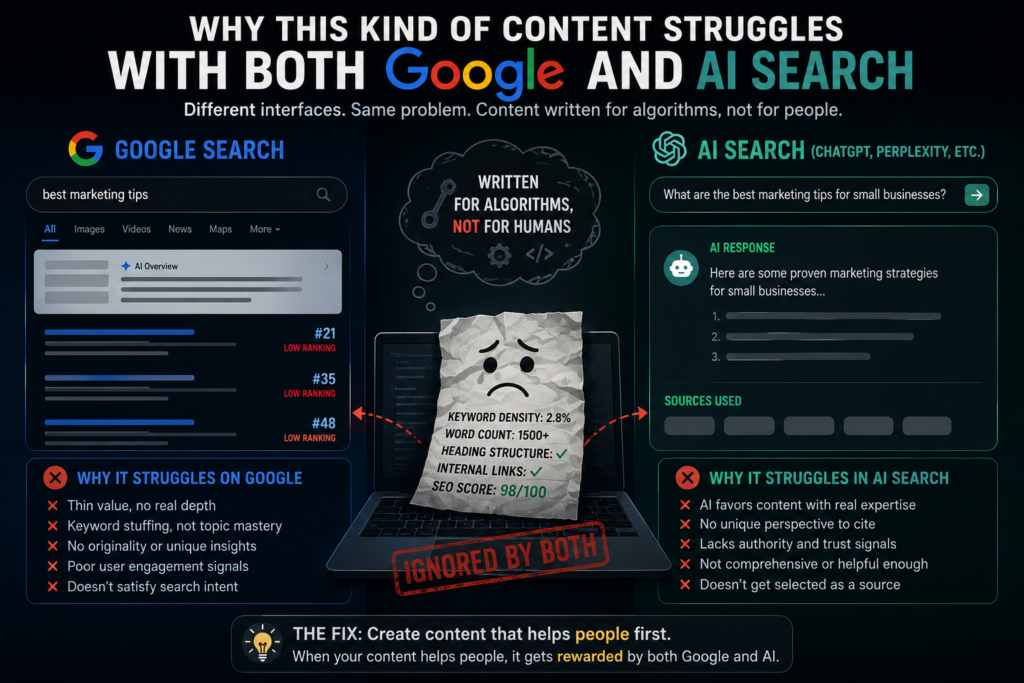
IIt is easy to assume Writing for AI, Google rankings, and artificial intelligence search visibility are three different things.
Traditional Search Engine Optimization
Traditional search engine optimization still leans on:
- relevance
- backlinks
- technical health
- keyword targeting
- and how users actually engage with your page on Google.
Artificial Intelligence Search

ai search. Think artificial intelligence overviews or chatbots.
Asks for all of that plus something extra:
- a clear, direct answer,
- real topical depth,
- factual accuracy,
- genuine insight
- and a structure that is easy to pull apart and summarize for people.
Here is the part that catches people off guard:
A page sitting at position number five on Google can get cited in an artificial intelligence answer simply because it explains something more clearly, brings original data to the table, or just demonstrates real expertise to people.
Artificial intelligence systems are not reading your rank on Google. They are reading how useful you actually are to people.
That said, artificial intelligence citations have not replaced rankings. Not even close.
Different artificial intelligence tools pull sources differently, and honestly, the whole space is still shifting under our feet.
The safest move now is to treat artificial intelligence visibility as an extra layer on top of solid search engine optimization, not a replacement for it.A strong digital marketing strategy should combine SEO, content, social media, and other channels rather than relying on one source of traffic.
The Eight-Step Process I Use to Fix Writing for AI Content
When I am reworking content that has fallen into this trap, I run through the steps every time:
1. Check Search Intent First For Google
What is this person actually trying to find or get done on Google?
2. Cut The Intelligence Style Filler For Google
Generic introductions, explanations, obvious padding. Gone from Google.
3. Bring In Experience And Examples For People
Observations, real numbers, actual steps.
This is what builds credibility fast for people.
4. Fix The Structure For People
Headings should answer questions, not just chase a keyword for Google.
5. Make The Language Sound Human For People
Vary your sentence length for people.Write like you are explaining it to someone across the table for people.
6. Check For Originality For People
Is this actually saying something competitors are not?Or just rephrasing what is already out there for people?
7. Optimize Search Engine Optimization Last For Google
Tighten keywords, internal links, titles, and metadata.
Never force them in for Google.
8. The Eight-Step Process I Use to Fix Writing for AI Content
Ask yourself: if I found this on Google, would it actually solve my problem for people?
Notice search engine optimization shows up near the end of that list, not the start.
That is on purpose for Google.
The Real Mistake: Trying to Sound Less Artificial Intelligence and More Useful
Here is where most people go wrong when they try to fix this for Google.
They try to make artificial intelligence-written content sound like artificial intelligence.
Swapping out words, tossing in filler transitions, rephrasing sentences just to dodge artificial intelligence detectors for Google.
That is the fix, and honestly, it wastes time for Google.
The goal was never to disguise the writing for Google.
It is to make the content genuinely more useful to the person reading it for people.
Once you focus on that. Answers, real examples, real structure.
The artificial intelligence-sounding quality tends to disappear on its own for people.
Generic phrasing and genuine insight rarely show up in the sentence for people.
One Thing to Do Today For Google
If you take one action after reading this, make it this one:
Read your content like the customer would, for people, not like the search engine optimization writer who built it. And cut anything that does not genuinely help them for people.
Most writing for intelligence problems traces back to the wrong priority from the start.
Chasing keywords, headings, and word count while forgetting the actual person on the other end of the page for people.
So ask yourself honestly:
If I landed on this page today for people, would it give me a better answer than everything else in the results for people?
If the answer is no for people, fix the usefulness first for people.
Search engine optimization can wait its turn for Google.
Frequently Asked Questions For Google
Does writing for intelligence search mean I should stop optimizing for Google?
No for Google.
Traditional search engine optimization. Relevance, technical health, backlinks.
Still matters as much for Google.
Artificial intelligence search visibility sits on top of that for people; it does not replace it for Google.
Can artificial intelligence generated content ever rank well for Google?
Yes, for Google.
Only once it is edited to include real expertise, original examples, and an actual answer to what the reader wants for people.
The problem was never AI assistance itself for Google.
It is content that stays generic for people.
How do I know if my content has fallen into the artificial intelligence content trap for Google?
Watch for this pattern:
- Impressions keep climbing for Google.
- Clicks and average position stay flat no matter how much more keyword work you do for Google.
The biggest problem with Writing for AI is not using AI itself. It is allowing optimization to become more important than usefulness.