Author name: sankarlal9645543@gmail.com

Writing for AI
blog

The AI Content Trap: Why Writing FOR AI Is Killing Your Rankings With Both Google AND AI Search

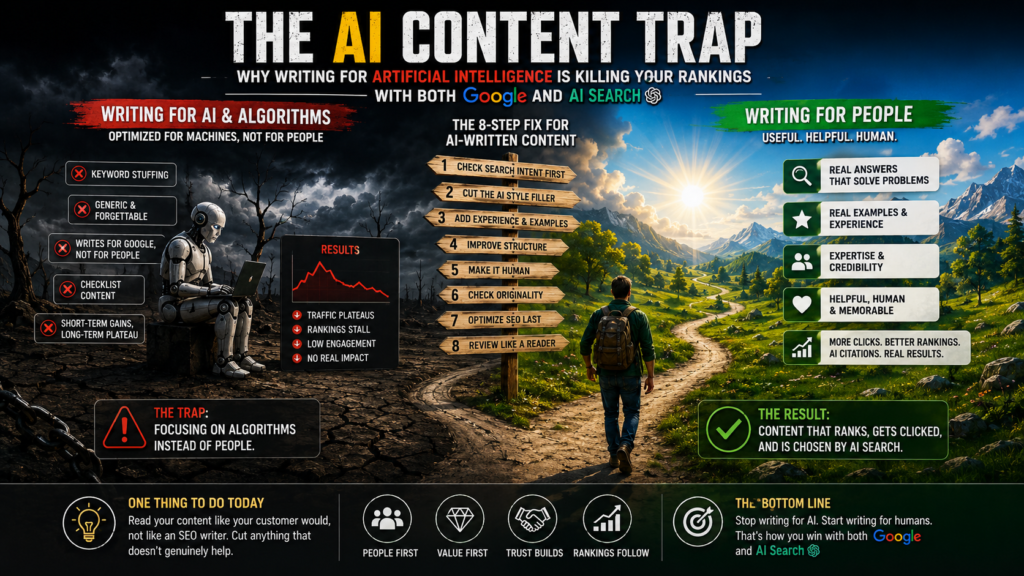
Why Writing FOR AI Is Killing Your Rankings Writing for AI instead of writing for people, here is the uncomfortable truth: your rankings probably are not doing what you think they are doing. You optimize the keywords for Google. You hit the word count that Google expects. You follow the heading structure that every search engine optimization checklist tells you to. For a while it actually works. Impressions climb; the page starts showing up on Google. Then it just stops. Clicks flatline on Google. Position barely budges on Google. No matter how much more keyword tweaking you throw at it, nothing moves on Google. That plateau is not luck. It is usually a sign that the content was written for intelligence and algorithms first. And for the person actually reading it second. Not at all. The content was written for Google and other search engines but not for people. What Writing For AI Actually Looks Like Once you know what to look for, this kind of content is easy to spot.Writing for AI often looks optimized on the surface, but the content can feel repetitive and predictable to real readers. I have seen this play out firsthand. One blog post I reviewed got a bump in impressions right after publishing, but clicks and average position barely moved after that, even with more keyword work poured into it. When I actually dug into the content, the pattern was obvious: It read fine on Google. It just did not say much to people. The fix was not search engine optimization. It was making the thing actually worth reading for people. It was making the content for people, not just for Google. Why Writing for AI Struggles With Google and AI Search IIt is easy to assume Writing for AI, Google rankings, and artificial intelligence search visibility are three different things. Traditional Search Engine Optimization Traditional search engine optimization still leans on: Artificial Intelligence Search ai search. Think artificial intelligence overviews or chatbots. Asks for all of that plus something extra: Here is the part that catches people off guard: A page sitting at position number five on Google can get cited in an artificial intelligence answer simply because it explains something more clearly, brings original data to the table, or just demonstrates real expertise to people. Artificial intelligence systems are not reading your rank on Google. They are reading how useful you actually are to people. That said, artificial intelligence citations have not replaced rankings. Not even close. Different artificial intelligence tools pull sources differently, and honestly, the whole space is still shifting under our feet. The safest move now is to treat artificial intelligence visibility as an extra layer on top of solid search engine optimization, not a replacement for it.A strong digital marketing strategy should combine SEO, content, social media, and other channels rather than relying on one source of traffic. The Eight-Step Process I Use to Fix Writing for AI Content When I am reworking content that has fallen into this trap, I run through the steps every time: 1. Check Search Intent First For Google What is this person actually trying to find or get done on Google? 2. Cut The Intelligence Style Filler For Google Generic introductions, explanations, obvious padding. Gone from Google. 3. Bring In Experience And Examples For People Observations, real numbers, actual steps. This is what builds credibility fast for people. 4. Fix The Structure For People Headings should answer questions, not just chase a keyword for Google. 5. Make The Language Sound Human For People Vary your sentence length for people.Write like you are explaining it to someone across the table for people. 6. Check For Originality For People Is this actually saying something competitors are not?Or just rephrasing what is already out there for people? 7. Optimize Search Engine Optimization Last For Google Tighten keywords, internal links, titles, and metadata. Never force them in for Google. 8. The Eight-Step Process I Use to Fix Writing for AI Content Ask yourself: if I found this on Google, would it actually solve my problem for people? Notice search engine optimization shows up near the end of that list, not the start. That is on purpose for Google. The Real Mistake: Trying to Sound Less Artificial Intelligence and More Useful Here is where most people go wrong when they try to fix this for Google. They try to make artificial intelligence-written content sound like artificial intelligence. Swapping out words, tossing in filler transitions, rephrasing sentences just to dodge artificial intelligence detectors for Google. That is the fix, and honestly, it wastes time for Google. The goal was never to disguise the writing for Google. It is to make the content genuinely more useful to the person reading it for people. Once you focus on that. Answers, real examples, real structure. The artificial intelligence-sounding quality tends to disappear on its own for people. Generic phrasing and genuine insight rarely show up in the sentence for people. One Thing to Do Today For Google If you take one action after reading this, make it this one: Read your content like the customer would, for people, not like the search engine optimization writer who built it. And cut anything that does not genuinely help them for people. Most writing for intelligence problems traces back to the wrong priority from the start. Chasing keywords, headings, and word count while forgetting the actual person on the other end of the page for people. So ask yourself honestly: If I landed on this page today for people, would it give me a better answer than everything else in the results for people? If the answer is no for people, fix the usefulness first for people. Search engine optimization can wait its turn for Google. Frequently Asked Questions For Google Does writing for intelligence search mean I should stop optimizing for Google? No for Google. Traditional search engine optimization. Relevance, technical health, backlinks. Still matters as much for Google. Artificial intelligence
AI in Digital Marketing
Uncategorized, blog

7 Powerful Ways AI in Digital Marketing Is Changing When Clicks Disappear

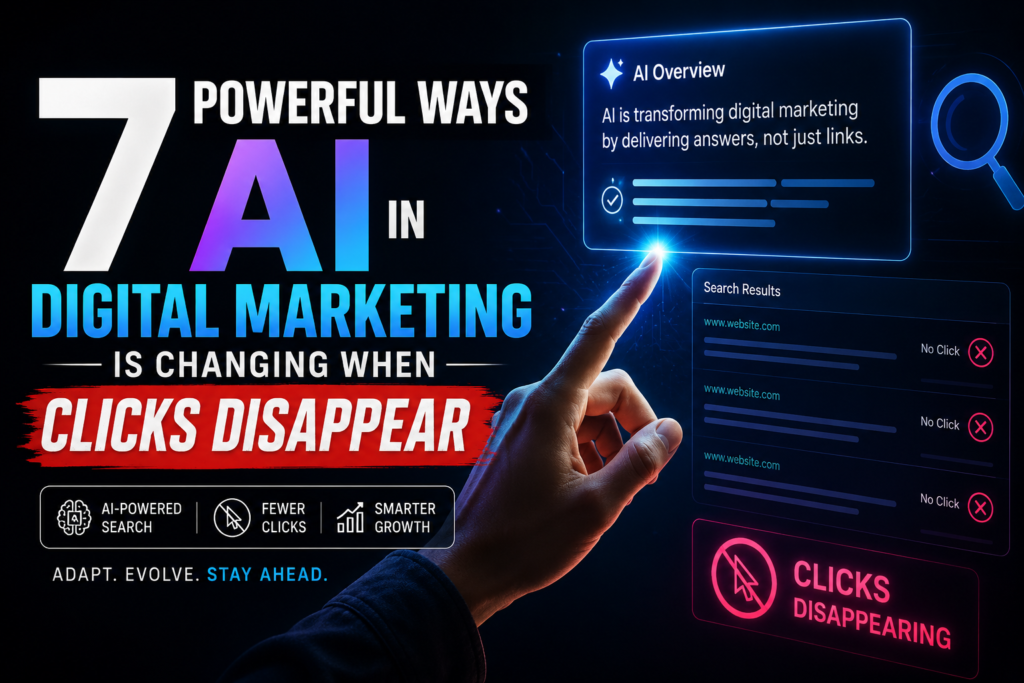
AI in Digital Marketing Is Changing When Clicks Disappear I remember when ranking on page one was the main goal. Someone would search, click on your site. That was it. That is not how it works anymore. AI in Digital Marketing has changed the whole search experience. Google’s AI Overviews now answer questions right on the results page. No click needed. I noticed this while studying SEO. It changed how I think about content. It is not about being number one. It is about being the answer.This shift makes AI in Digital Marketing an important part of modern SEO strategies. That is also why I focus on combining SEO, content, and AI-driven strategies in my digital marketing services to help businesses stay visible as search continues to change. If you are a business owner, marketer, or freelancer and your traffic numbers look off even though your rankings are fine. This is why. Here are seven ways AI is changing search and what you can do about each one. 1. AI Overviews Are Eating the Click One of the biggest changes AI in Digital Marketing has created is the AI Overview box. For searches, it summarizes the answer from multiple sources, and the searcher gets what they want without scrolling down to your site. This is what we call “zero-click search”. It is why rankings and traffic are not connected like they used to be. You can rank well. Still see your visits drop. So do not measure success by rank position alone. Use Google Search Console to track impressions versus clicks. That gap tells you more than position does. 2. Search Intent Now Has a Third Audience: The AI Itself SEO used to be written for two audiences. The reader and the algorithm. Now there is one. The AI model that summarizes your content for someone else. This is where AI marketing strategies need to go beyond keywords.This is becoming a key part of AI in Digital Marketing strategies. Across my client work, I see a pattern: content that answers the question early and clearly gets pulled into AI summaries more often than content that takes its time. So do not bury your insight in paragraph five. Say what you mean in the two or three sentences, then explain. Not before. 3. Generative Engine Optimization (GEO) Is a New Layer on Top of SEO This is a major shift in my AI in Digital Marketing workflow. Alongside SEO, I structure content so AI crawlers can lift and cite it cleanly. Some people call this GEO; some call it AEO. It is about making content work for AI. In practice, that looks like: I see a pattern across projects: content built this way gets picked up and referenced more. 4. Keyword-First Content Is Losing Ground I still see people writing around a keyword of a real question.For AI in Digital Marketing, understanding the user’s actual question is more important than simply repeating a keyword. A page that stuffs a keyword in ten times reads awkwardly to a human. It gives an AI model nothing to summarize. These systems pull out meaning and intent, not match strings of text. So flip it. For every keyword, write down the question a real person would type. Answer that question first. The keyword shows up because you are writing normally. 5. Trust Signals Matter More Than Ever When an AI model picks which sources to cite, it leans toward stuff. Real authorship, accurate claims, evidence. This tracks with Google’s E-E-A-T idea. Experience, Expertise, Authoritativeness, Trustworthiness. Google’s Search Quality Rater Guidelines use -E-A-T to judge content. That is not a search-engine checkbox. It is how people and AI decide what is worth trusting.That makes trust an important factor in effective AI in Digital Marketing. Practically, that means examples, named tools, actual numbers, and being upfront about limitations. “Many businesses see results” says nothing. Specificity signals you have done the work. 6. Local and Service-Based Businesses Feel This Differently If you run a business or offer a service, zero-click search does not hit you the same way. People still need to do something. Book a call, visit a location, request a quote. This is where structured content still earns its keep. Clear service pages, location details, and a direct call to action give both the reader and the AI system something concrete. Make sure your key pages answer “what do you offer, where and how do I reach you” in the few lines.For local businesses, AI in Digital Marketing can help turn online visibility into real enquiries and customers. 7. Measurement Itself Needs to Change If you judge content by click volume, you only see half the picture. Some of your valuable exposure now happens when your brand gets referenced inside an AI answer. No click involved. Worth tracking: None of these replace direct traffic, but together they give a more honest read on visibility. FAQs “Does AI in Digital Marketing mean SEO is dying?” No. Search intent still matters; rankings still matter; organic traffic is still valuable. What is changing is that visibility now includes getting cited or summarized by AI. What’s the difference between SEO and GEO? SEO is about ranking in search results. GEO is about getting your content understood and cited by AI systems. In practice, the two overlap. How do I know if AI Overviews are affecting my traffic? Compare Search Console impressions to clicks. If that gap is widening, that is your answer. Final Thoughts The click is not guaranteed anymore… The chance to be trusted, cited, and remembered still is. AI in Digital Marketing is not out to kill good content; it rewards real answers over ranking tricks. If you take one thing from this and act on it: pick your performing page and rewrite the opening two sentences so they answer the question immediately. That is the most practical starting point for adapting your AI marketing strategies.

how to get more customers
Uncategorized, blog

How to Get More Customers Without Spending More on Ads: 12 Proven Ways

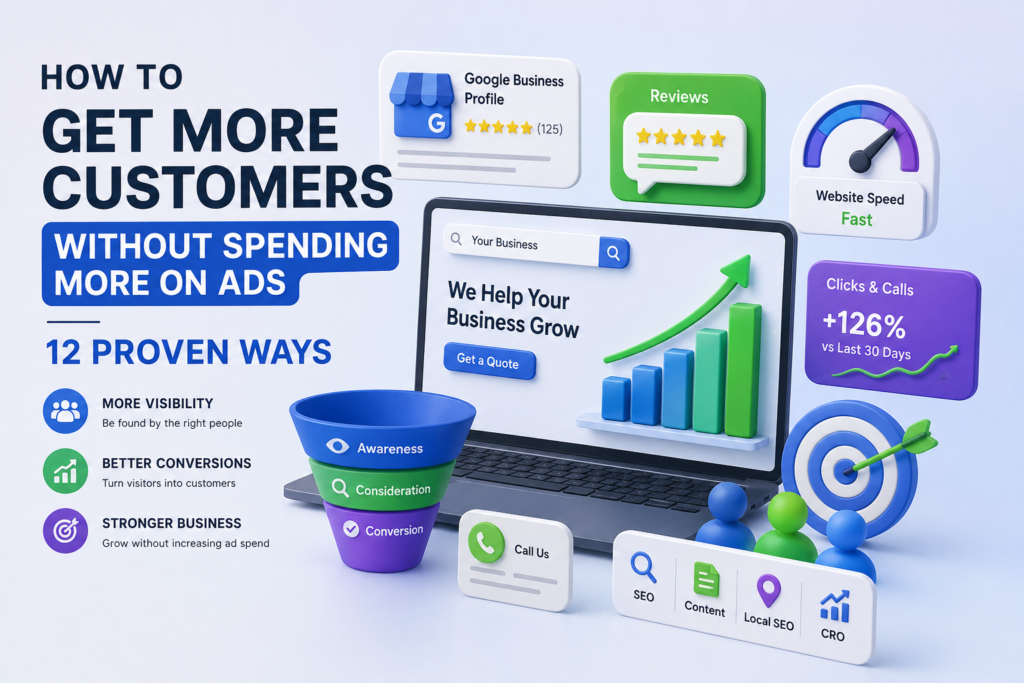
how to get more customers If sales feel slow, your first thought is probably to raise the ad budget. I get it — it feels like the obvious move. But honestly, it’s not always the smart one. If you’re looking for how to get more customers without touching your ad spend, the real question to ask first is: are you actually making the most of the customers who are already finding you? I have faced this problem with local businesses, and one case remains with me. A business owner came to me certain the only solution was an ad budget. Instead, I took a different route. SEO and conversion rate optimization. I found the keywords that actually convert, improved their service pages, fixed their Google Business Profile, wrote content focused on their area, and made it easy for people actually to get in touch. I also made their site faster. Added CTA buttons that were easy to see. No single rupee was used for ads. Organic traffic increased, conversions improved, and inquiries followed, all without touching the ad budget.If you want to achieve similar results for your business, explore my SEO services. That experience changed how I approach growth now: fix the leaks before you pour in traffic. If you’re wondering how to get more customers without spending more on ads, these 12 strategies are where I’d start. 1. Start With Your Google Business Profile Your Google Business Profile is one of the fastest ways to learn how to get more customers in your local area.If you are a business just starting, this is where I would send you first. Get the basics right. Information, the right categories, good pictures, and a regular flow of reviews. And you will usually see a boost in visibility on Google Maps pretty quickly. More calls, visits, more directions requested. Out of all the items on this list, this one tends to move the fastest.For many local businesses, this is one of the fastest ways to get more customers without increasing marketing costs. 2. Get Reviews. Actually Respond to Them Reviews do two things. They create trust with people who are checking you out. They tell Google’s local algorithm that you are relevant. A thin or ignored review section is one of the ways local businesses lose customers. Long before ads even come into the picture. 3. Deal With Slow Page Speed A slow site hurts conversions in a way. Someone clicks through from a search or a social post, waits a few seconds, and leaves for your competitor instead. Speeding up your site is not work, but it stops you from losing traffic that you did not pay extra for. 4. Make It Easy to Contact You Look at your website like you are a stranger. Is it clear how to call, message, or book you? Every extra click, every form field is a customer walking away for free. Fixing this one thing can increase your inquiries without spending anything. 5. Put Clear CTAs Everywhere Don’t make visitors guess what to do. “Call Now,” “Get a Free Quote,” “Book Today”. Simple, repeated CTAs across your site do a lot of the work that people think only ads can do. 6. Go After Keywords That Actually Convert If your goal is to get more customers, targeting buyer-intent keywords is far more effective than chasing high-volume searches.Not all traffic is worth chasing. Big general keywords look good in a report. High-converting local keywords. The ones people type right before they are ready to call or buy. Bring in visitors who are much more likely to become paying customers. 7. Rework Your Service Pages Your service pages have more impact than people give them credit for. A clear page that actually answers what someone is wondering. Pricing, process, whether you serve their area. Converts better than ads ever will. 8. Write Content for Your Actual Area Neighborhood guides, local case studies, pages specific to your location. This kind of content puts you in front of the exact searches your future customers are making. It builds long-term SEO along with your Google Business Profile. 9. Run a Conversion Audit Many businesses trying to get more customers focus only on traffic instead of improving conversions.This is the mistake I often see: business owners focus on getting traffic while ignoring the traffic they already have. A conversion audit. Checking for a design, weak CTAs, and confusing navigation. Usually finds more “free” customers than another round of ad spend would. 10. Get Your Business Listed Consistently Make sure your name, address, and phone number are the same across directories. It sounds small. It strengthens your local SEO and your Google Business Profile, and it makes it easier for both Google and real people to trust that you are real. 11. Put Testimonials on Your Site Real results from real people are better than anything you could write yourself. Featuring outcomes and testimonials does the same trust-building work that an ad is trying to buy. Except it is already on your site for free. 12. Fix the Foundation Before You Scale Learning how to get more customers starts with improving what already exists before investing in more advertising.If the idea of not spending more on ads makes you nervous, here’s the thing to remember: ads are not the way to grow. Get your website, your Google Business Profile, and your reviews working first. If you are already losing customers to poor visibility or a confusing website, more ad spend just gives you more missed chances. Fix the base. Then grow with ads once your business is ready to convert what it earns. How Fast Should You Expect Results? Businesses that consistently apply these strategies usually get more customers over time through organic search and better conversions.It is important to set expectations. An optimized Google Business Profile can start to show results. More visibility, more inquiries. Within a few weeks. SEO is a process, usually 3 to 6 months before you

cost of skipping SEO
blog

hidden cost of skipping seo in 2026

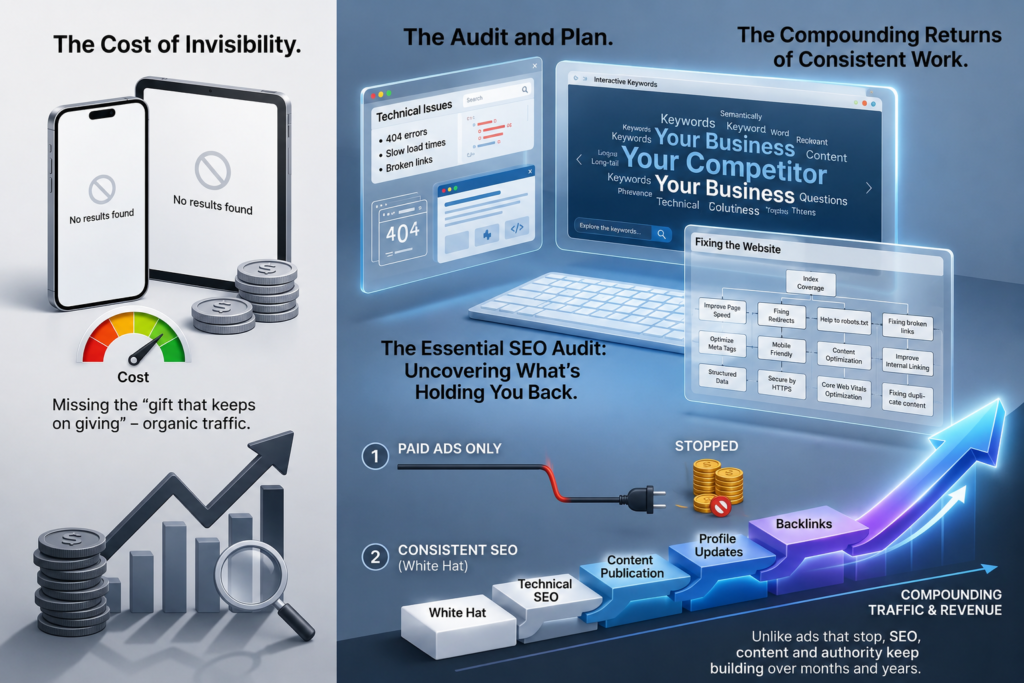
What Is the Cost of Skipping SEO? Cost of Skipping SEO starts the moment your business stops investing in search engine optimization. If your business is not using search engine optimization, you are basically giving your competitors a way to get to your customers. Your competitors will get to your customers if you do not use search engine optimization. Many business owners rely only on paid ads and word of mouth to get customers. This is okay, I guess. It seems like the way to get people in the door. But here is the thing: search engine optimization is what makes your business visible to people who are already looking for what you offer that is search engine optimization. Every month you are not showing up on Google, someone else is getting the customer who was looking for your business, and that someone else is getting the customer because of search engine optimization. Many business owners lean on paid ads and word-of-mouth referrals to bring in customers, not realizing the cost of skipping SEO keeps climbing every month they wait. A Real Example: The Cost of Skipping SEO in Action One company was relying completely on paid advertisements and referrals to get customers. At the time, their competitors were getting ahead by showing up in Google search results without paying for ads. We helped this company by rebuilding their website. We cleaned up the pages that described their services. We figured out what words their real customers were using to search for them. We made the website load faster. We also started publishing content on a regular basis. After a month, we started to see some results. The number of people visiting their website from Google searches increased to two and a half times what it was before. They used to get twelve to fifteen leads every month, but now they were getting thirty-five to forty. Some of the keywords they wanted to be known for were even showing up on the page of Google search results. The best part was what this meant for the company in the run. They were no longer forced to keep spending money on ads to get customers. They had a steady stream of leads coming in all the time without having to pay for each one. This is the kind of growth that keeps getting bigger and bigger over time, as soon as they stop paying for ads. The true cost of skipping SEO is measured in lost traffic, lost leads, and lost revenue.It’s the same gap we help close through our services.The Google search results for their company were like a gift that kept giving, and they did not have to keep paying for it. This is a clear picture of the cost of skipping SEO and what changes once a business finally stops paying it. Why Waiting to Invest in SEO Is Expensive: The Real Cost of Skipping SEO The biggest mistake business owners make is thinking of search engine optimization as something they have to pay for or something that will make them money. Search engine optimization is more than that. Meanwhile, competitors keep getting better rankings for keywords and gaining more trust on Google because they invest in search engine optimization. Every day you wait is another day your competitors get ahead. The delay does not just cost you website visitors. It costs you leads and sales while giving your competitors an advantage that becomes harder to overcome. The Long-Term Benefits of SEO vs. the Cost of Skipping SEO A Quick SEO Checklist to Avoid the Cost of Skipping SEO A quick way to check if you are losing money by ignoring search engine optimization is to ask yourself: If most of these are spots you are not just missing people visiting your site; you are quietly losing leads and revenue every month without realizing it. You are losing because you do not use search engine optimization. Where to Start So You Avoid the Cost of Skipping SEO If you are not sure where to start, begin with a search engine optimization audit. Begin because search engine optimization is necessary. Do not throw money at ads or rebuild your website without a plan. An audit tells you exactly what is holding you back: technical issues, missed keywords, content gaps, and where you stand against competitors, and an audit is part of search engine optimization. Once you know that, you can fix things in the order of trying to do everything at once, and you can fix things because of search engine optimization. The sooner you start, the sooner your site starts building authority, pulling in traffic, and generating leads. It all happens because of search engine optimization. Conclusion Skipping search engine optimization does not mean nothing happens; it means your competitors get the customers you should have had, and they get the customers because you do not use search engine optimization. The cost is invisible until you look at the leads that never found you, and you can see the cost because you do not use search engine optimization. Start with an audit, fix what needs fixing, and give it time to compound, and all of this is part of search engine optimization.Businesses that delay SEO usually face a much greater cost of skipping SEO in the future. The businesses that start today will be the ones on page one of Google while their competitors are still debating whether search engine optimization is worth it. They will be on page one because of search engine optimization.`

Scroll to Top